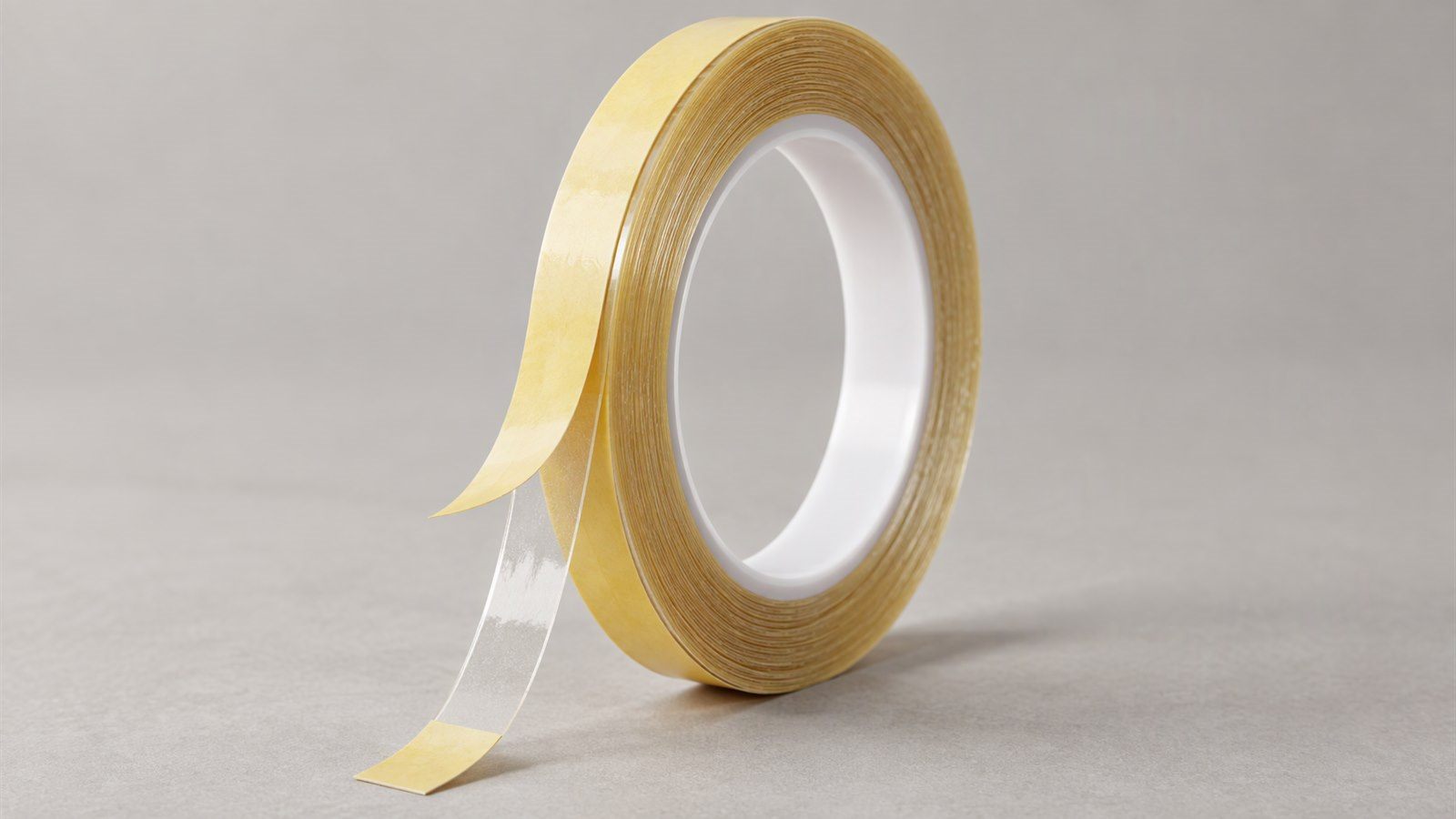
Double-Sided Tape
PET, non-woven, transfer and tissue tapes for electronics, automotive and appliance assembly.
View productThe carrier decides how a double-sided tape behaves under heat, shear and die-cutting. Here is how to choose between PET, non-woven, tissue and transfer constructions.
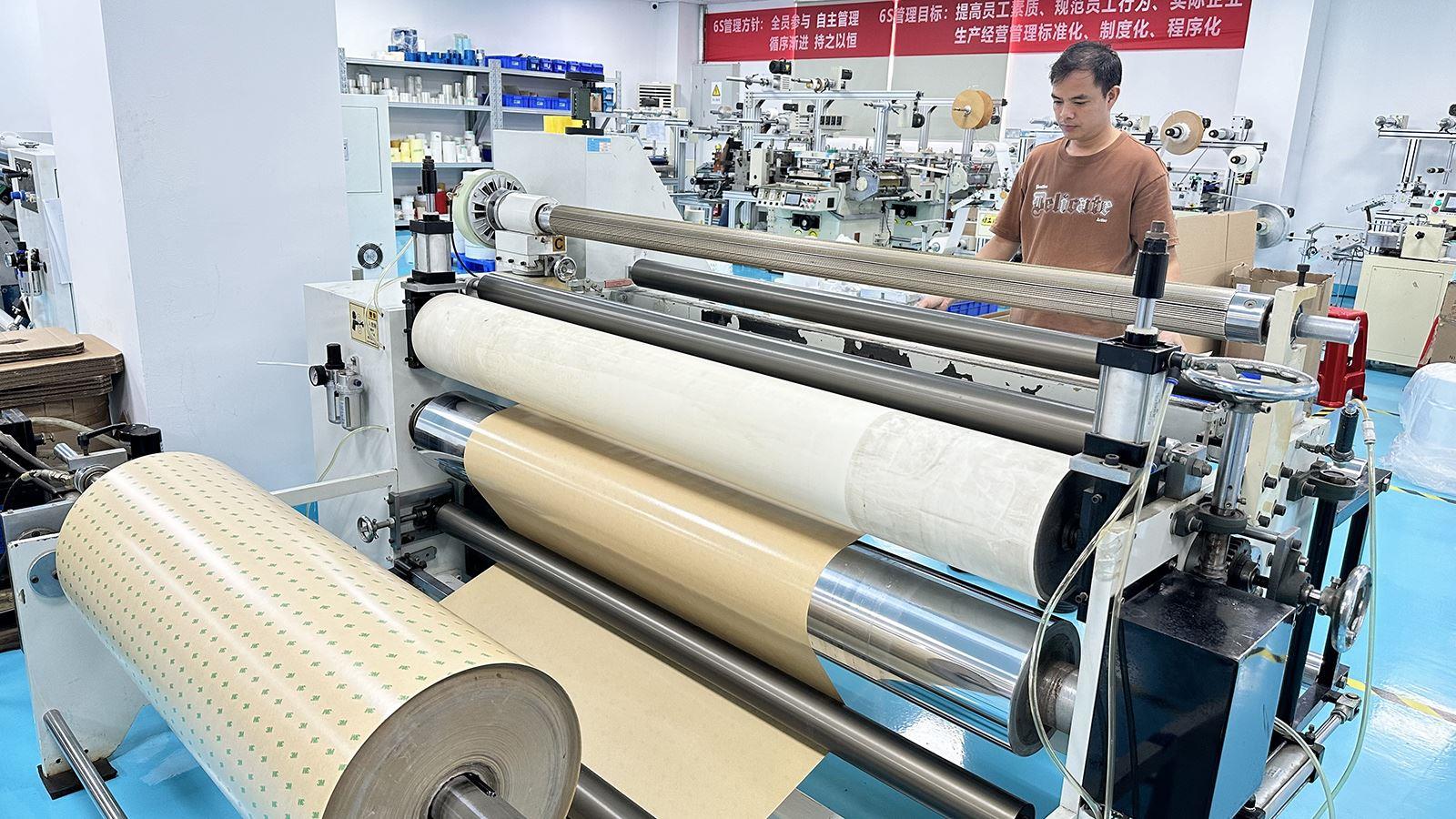
Two tapes can share the same adhesive and still fail differently, because the carrier in the middle controls dimensional stability, conformability and shear strength. This guide explains what each carrier does, where it belongs, and how to validate a choice before you commit to production.
A double-sided tape is a sandwich: release liner, adhesive, carrier, adhesive, release liner. Buyers often compare only thickness and peel adhesion, but the carrier determines how the tape behaves when it is heated, stretched, die-cut or bonded to a curved surface.
A PET film carrier keeps its shape. A non-woven carrier stretches and conforms. A transfer tape has no carrier at all, so the adhesive itself must carry the load. None of these is universally better; each solves a different assembly problem.
PET double-sided tapes use a polyester film carrier, typically 12 to 50 micrometres thick. The film gives the tape high tensile strength, low elongation and good dimensional stability, which matters for parts that must stay within a narrow tolerance after die-cutting.
PET constructions handle higher temperatures than tissue or non-woven products and resist oozing under pressure. They are the default choice for display bonding, battery fixing, FPC reinforcement and any application where the adhesive must not flow into a gap or contaminate a nearby component.
Non-woven carriers are made from bonded fibres; tissue carriers use paper. Both are softer and more conformable than PET film, so they follow slight curves, stamped surfaces and textured plastics. They are also usually less expensive.
The trade-off is lower dimensional stability and lower shear strength. A non-woven tape can stretch during hand application, and its cut edges may fray or show adhesive squeeze-out. For automotive interior trim, appliance panels and general assembly this is often acceptable and cost-effective. For a display module with a 0.2 mm bond line, it usually is not.
| Property | PET film | Non-woven | Tissue | Transfer (no carrier) |
|---|---|---|---|---|
| Dimensional stability | High | Medium | Medium | Low to medium |
| Conformability | Low | High | High | Very high |
| Shear strength | High | Medium | Medium | Adhesive dependent |
| Die-cut edge quality | Excellent | Good | Good | Excellent |
| Typical bond line | 0.05–0.25 mm | 0.10–0.30 mm | 0.08–0.20 mm | 0.03–0.10 mm |
| Relative cost | Higher | Medium | Low | Medium |
Transfer tape is adhesive with a liner on both sides and no carrier. It is used where the bond line must be as thin as possible, such as display module assembly, FPC reinforcement, heat spreading and precision electronics.
Because there is no carrier, transfer tape is delicate to handle and can stretch during application. The liner choice becomes part of the design: a rigid PET liner supports automated placement, while a flexible liner suits manual application. Specify the liner, not just the adhesive.
Carrier selection is only half the decision. Adhesion depends on surface energy. Metals, glass and many engineering plastics such as ABS and PC bond readily. Polypropylene, polyethylene, powder-coated surfaces and some recycled plastics are low surface energy and need an LSE-grade acrylic adhesive or a primer.
Always clean the surface with isopropyl alcohol and let it dry. A release agent, mould release or oil film can reduce adhesion dramatically even when the tape is correct.
| Substrate | Surface energy | Typical approach |
|---|---|---|
| Aluminium, stainless steel | High | Standard acrylic or rubber adhesive |
| Glass, ABS, PC, rigid PVC | Medium to high | Standard acrylic adhesive |
| Powder-coated metal | Low to medium | LSE acrylic or primer; test the actual coating |
| PP, PE, TPE | Low | LSE acrylic adhesive plus surface testing |
| Silicone, PTFE | Very low | Usually not suitable for pressure-sensitive tape |
Southeast Asia combines high temperature, high humidity and strong UV. A tape that passes a 24-hour peel test in an air-conditioned lab may still creep in a warehouse or on a vehicle exterior. Ask for heat aging, humidity aging and static shear data at the temperature the product will actually see.
Storage matters too. Keep cartons sealed, out of direct sunlight and below roughly 30 °C. A roll that has softened in a hot container may not apply cleanly even if the grade is correct.
Run the same test on the candidate tape and on the material you use today. Document substrate, cleaning method, application pressure, dwell time and test conditions so the result can be repeated.
This guide is general technical information, not a substitute for testing the selected material on your substrate and process. Values are grade dependent; confirm the current TDS before approval.
PET, non-woven, transfer and tissue tapes for electronics, automotive and appliance assembly.
View product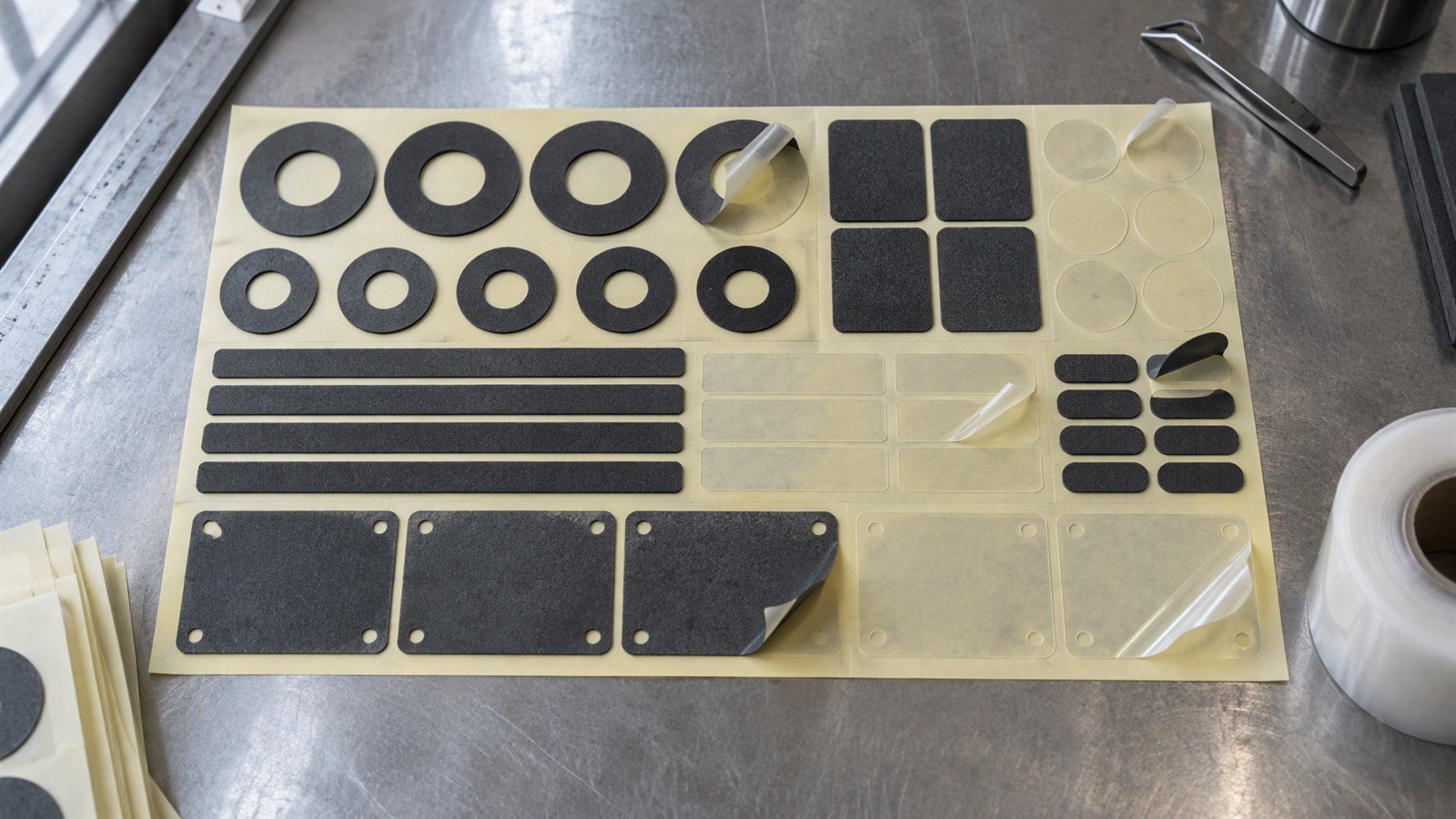
Custom adhesive parts from drawing to ready-to-install: flat-bed, rotary, laser cutting and kitting.
View product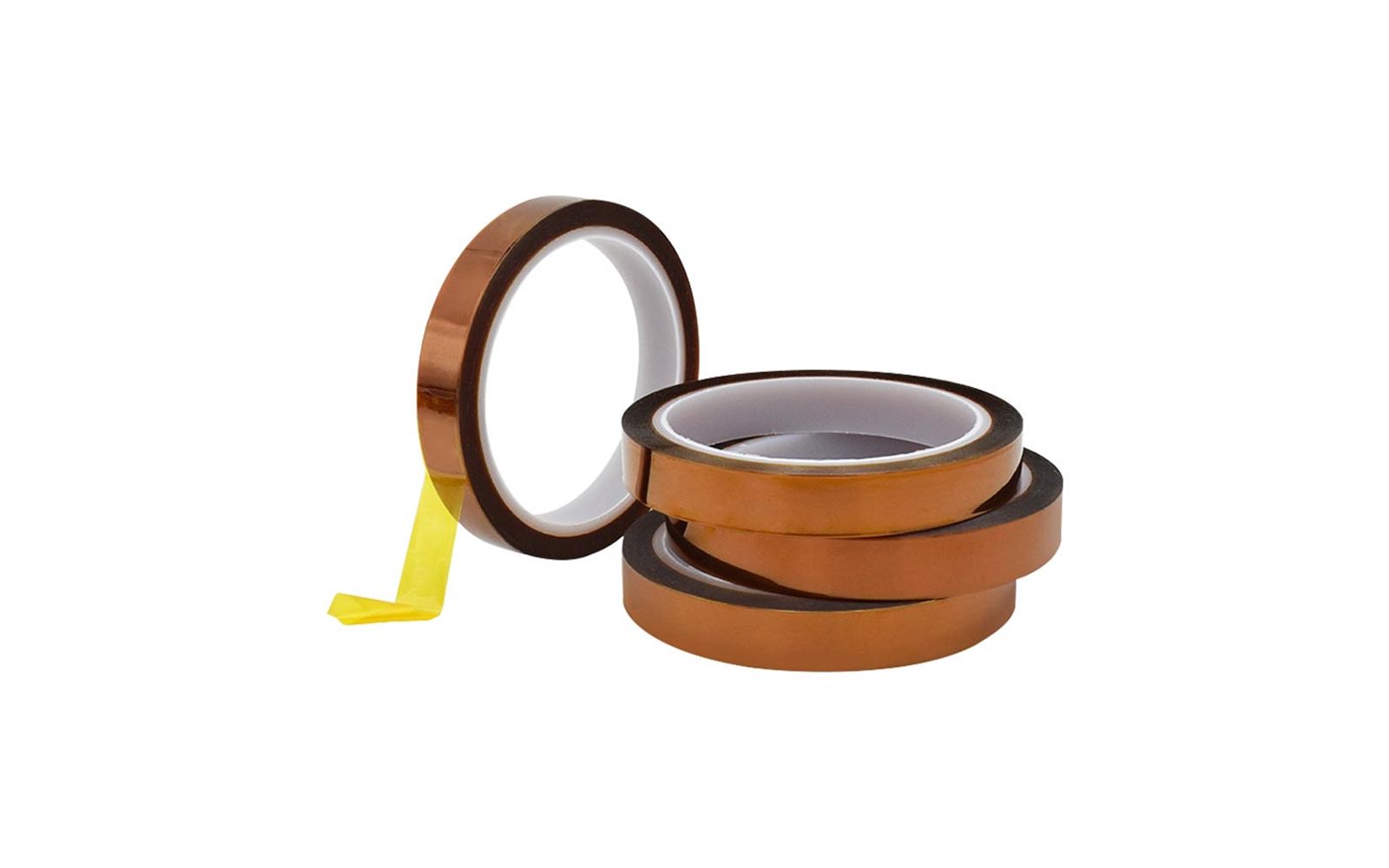
Conductive, polyimide, aluminum foil and thermal tapes for grounding, shielding, insulation and high-temperature protection.
View productSend the substrate, environment and drawing. We will propose a construction and a validation plan.